

PRTD APPROVED! When the Story Behind the Absence Matters
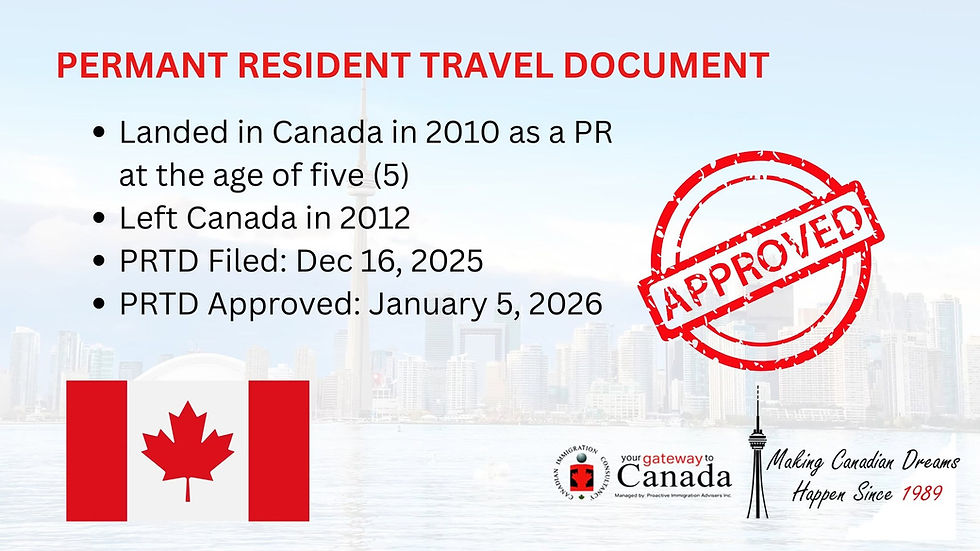
Another successful Permanent Resident Travel Document (PRTD) application by Gateway to Canada!
Our client had been a permanent resident of Canada since 2010, but had been outside Canada since 2012.
On paper, the situation looked difficult.
The client had spent many years outside Canada and clearly did not have the required 730 days of physical presence in Canada during the relevant five-year period.
But immigration cases are not always about numbers alone.
The circumstances behind the absence mattered
The applicant left Canada as a minor and remained outside Canada because of financial hardship and family circumstances.
The circumstances were important because the applicant did not simply make a deliberate decision to abandon Canada and their permanent resident status.
Our submission focused on the humanitarian and compassionate (H&C) considerations surrounding the applicant's history.
We presented the circumstances that contributed to the applicant remaining outside Canada, including:
the applicant's young age at the time;
circumstances that were substantially beyond the applicant's control;
the financial and family difficulties that contributed to the prolonged absence;
the applicant's history and connection with Canada; and
the reasons why retaining permanent resident status was justified despite the residency obligation issue.
Canadian immigration law expressly allows humanitarian and compassionate considerations to be considered when a permanent resident has not complied with the residency obligation. If an officer determines that those considerations justify retaining PR status, that determination can overcome the breach of the residency obligation.
IRCC's PRTD guidance similarly recognizes that exceptional circumstances or factors beyond a person's control may be relevant to an H&C assessment. Applicants must explain why they could not meet the residency obligation and provide evidence supporting the circumstances relied upon.
PRTD applications are about more than counting days
The general rule is straightforward: permanent residents are normally required to meet a 730-day residency obligationover the applicable five-year period.
But when someone has fallen short, the question should not simply be:
“How many days were you in Canada?”
It should also be:
“Why weren't you in Canada?”
And, where appropriate:
“What humanitarian and compassionate considerations justify allowing you to retain your PR status?”
That distinction can be critical.
In this case, the applicant's age when the circumstances began, the lack of control over those circumstances, and the applicant's genuine connection to Canada formed an important part of the case.
The result?
PRTD APPROVED.
Filed: December 16, 2025Approved: January 5, 2026
The approval means the applicant can use the PRTD to facilitate travel back to Canada as a permanent resident. Under the Immigration and Refugee Protection Act, a PRTD may be issued where an officer is satisfied that the residency obligation is met or where the officer has made the required H&C determination justifying retention of PR status.
Don't assume your PR status is automatically gone
If you have been outside Canada for years, don't automatically assume that your Canadian permanent resident status is already lost.
IRCC states that a person does not automatically lose PR status simply because they have not met the residency obligation. Status is lost only following a formal determination or another legally recognized event.
Every case is different.
The strength of a PRTD application may depend not only on your travel history, but also on the complete story behind your absence from Canada, the evidence available, your circumstances, your ties to Canada, and the humanitarian considerations that may apply.
PRTDs are about context—not just days.
If you are a Canadian permanent resident who has been outside Canada for an extended period and need to return to Canada, Gateway to Canada can help assess your situation and determine how your circumstances may be presented in a PRTD application.
Another #GatewayToCanada success story.
This post is for general information only and does not constitute legal advice. Each PRTD application is assessed based on its own facts and evidence. If you need assistance with your PRTD Application, take our free online assessment.


Comments